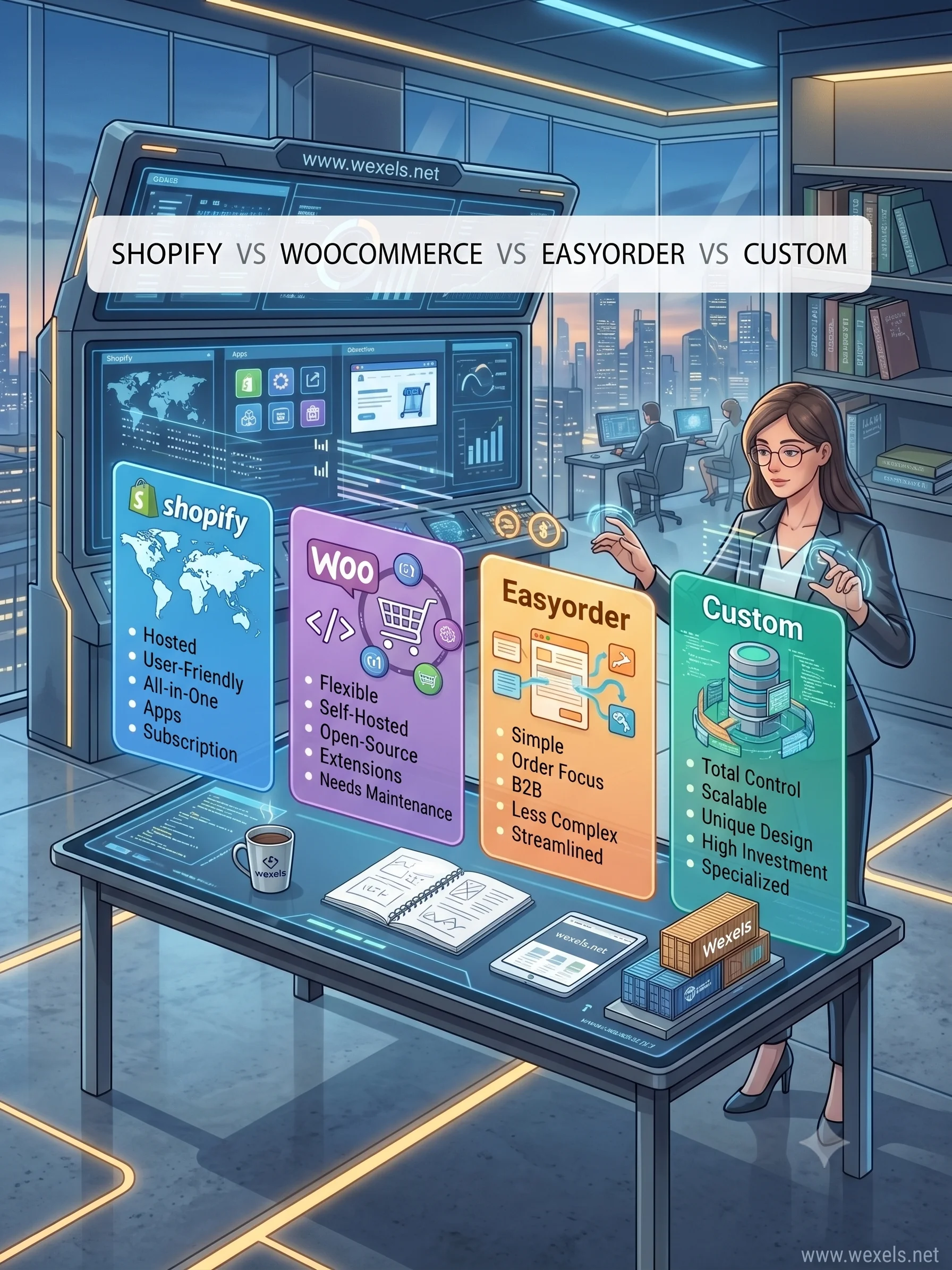
Choosing the right e-commerce platform for startups is no longer just a technical hurdle; it is a foundational business decision. In the 2026 startup landscape, the platform you select dictates your ability to scale, your operational overhead, and your ultimate speed-to-market.
Many founders face "choice paralysis." You see dozens of options, from massive SaaS giants to niche ordering systems and fully bespoke custom builds. It is easy to get lost in the feature lists and miss the bigger picture.
The reality is that there is no single "best" platform. The right choice depends entirely on three variables: your specific business goals, your technical literacy, and your current budget. If you choose a tool that doesn't align with these, you risk stalling your growth before you've even hit your first milestone.
Shopify vs. WooCommerce: Speed vs. Ownership
When looking for the best e-commerce platform for startups, the debate almost always begins with the heavyweights: Shopify and WooCommerce. These two represent the fundamental trade-off between convenience and control.
Shopify is the gold standard for the "ready-to-go" SaaS (Software as a Service) model. For a startup that needs to be live by next week, Shopify is often the most logical path. It handles the hosting, security updates, and PCI compliance out of the box.
In 2026, the Shopify app ecosystem is more mature than ever. You can plug in almost any functionality—from advanced loyalty programs to complex shipping rules—with a few clicks. However, this convenience comes with a recurring price tag. Between monthly subscription fees and the "app tax," costs can stack up quickly as you add more features.
On the opposite side of the spectrum is WooCommerce. As an open-source plugin for WordPress, it offers near-infinite flexibility. You own your data, your code, and your environment. For a startup with a technical co-founder or a dedicated development team, this ownership is a massive advantage.
However, WooCommerce is not "set it and forget it." You are responsible for your own hosting, security patches, and plugin compatibility. In 2026, the cost of WooCommerce isn't necessarily in the software license, but in the maintenance hours required to keep the site performant and secure. If your team doesn't have the bandwidth for manual updates, the "flexibility" of WooCommerce can quickly turn into a technical bottleneck.
Evaluating Easyorder and Custom Coded Solutions
While Shopify and WooCommerce dominate the general storefront market, other solutions are designed for specific workflows. This is where many startups find their "sweet spot."
Easyorder is a prime example of a niche-specific platform. Unlike a general storefront designed to sell physical products globally, Easyorder excels in specific ordering workflows. If your startup model relies on recurring service orders, complex booking, or specific logistical flows that standard e-commerce tools struggle to map out, Easyorder can be a superior choice. It solves the "workflow" problem rather than just the "checkout" problem.
Then, there is the "Custom Coded" route. This is the ultimate bespoke solution, where every line of code is written to serve your unique business logic.
For a startup, custom development is a high-stakes move. The advantages are clear: you have 100% uniqueness and no limitations on how the platform functions. You can build proprietary features that your competitors can't replicate.
The downside, however, is the barrier to entry. Custom builds require significant upfront investment and a much slower time-to-market. For an early-stage startup, spending six months building a bespoke engine before you’ve validated your product-market fit is often a mistake. Unless your business logic is so unique that it cannot be supported by standard APIs, custom coding is usually a "scale-later" strategy rather than a "launch-now" strategy.
The 2026 Decision Matrix: Which to Choose?
If you are looking for a direct answer, here is the most efficient way to view the current landscape. To choose the best e-commerce platform for startups in 2026, you must match your immediate priority to the right tool.
Choose Shopify if:
- You need to launch rapidly (within days or weeks).
- You prefer a predictable monthly cost over managing servers.
- You want a "plug-and-play" ecosystem where you can outsource the technical heavy lifting.
Choose WooCommerce if:
- You need deep customization of the checkout or user experience.
- You have an existing WordPress infrastructure or a team comfortable with self-hosting.
- You want to avoid recurring "per-app" fees by managing your own plugins and updates.
Choose Easyorder if:
- Your primary need is a specific ordering workflow (like service-based scheduling or complex fulfillment).
- A standard "shopping cart" experience doesn't accurately reflect how your customers interact with your business.
Choose Custom Coded if:
- You have a proprietary technology or unique business logic that no existing API can support.
- You have the funding and time to build a unique asset from the ground up.
- You are planning to scale to a level where standard platform limitations would become a significant revenue risk.
Quick Decision Checklist:
- Is your launch date less than 30 days away? → Go Shopify.
- Do you need a specific, non-standard ordering flow? → Look at Easyorder.
- Do you have a unique feature that requires a custom database? → Go Custom Coded.
- Do you want total control over your site’s code on a budget? → Go WooCommerce.
Outcome
The best e-commerce platform for startups is the one that aligns with your 12-month roadmap. If your goal for the next year is rapid experimentation and sales, don't over-engineer your tech stack with a custom build. If your goal is to build a unique, proprietary service, don't let the limitations of a generic SaaS platform hold you back.
Before you commit to a platform, perform a technical audit of your requirements. Write down exactly how a customer moves from "landing page" to "thank you" page. Identify the "must-have" features versus the "nice-to-have" ones.
Choosing the right architecture today ensures that your platform becomes a launchpad for your growth, rather than a ceiling that keeps you small.
Ready to build? Contact Wexels to audit your technical requirements and select the right architecture for your 2026 launch.